Urumqi - Xinjiang Province - China
Plant Hunting Trip 21.05.05 - 28.05.05
(Australian Rose Annual - 2006)
My husband Laurie and I visited China at the end of April (to attend that country’s first National Rose Show), and again at the end of May and I thought you may be interested in our May trip as it involved our first venture into that wonderful world of plant hunting.
Some readers may be aware that a few years ago Laurie made a donation of roses to the Director of the Beijing Botanical Garden (Mr Zhang Zuoshuang) and created an Old Rose Garden within his Botanical Garden – this garden was officially opened with the assistance of the Australian Consulate in Beijing in May 2003 and has been named the “Sino-Australia Friendship Rose Garden”. Laurie has since made numerous subsequent visits to those Gardens to share his knowledge with workers on how to care for those roses, and has also given talks to members of staff at the Gardens and to students at the Beijing Forestry University, and it is during these visits that we are warmly received by the Director and his Staff.
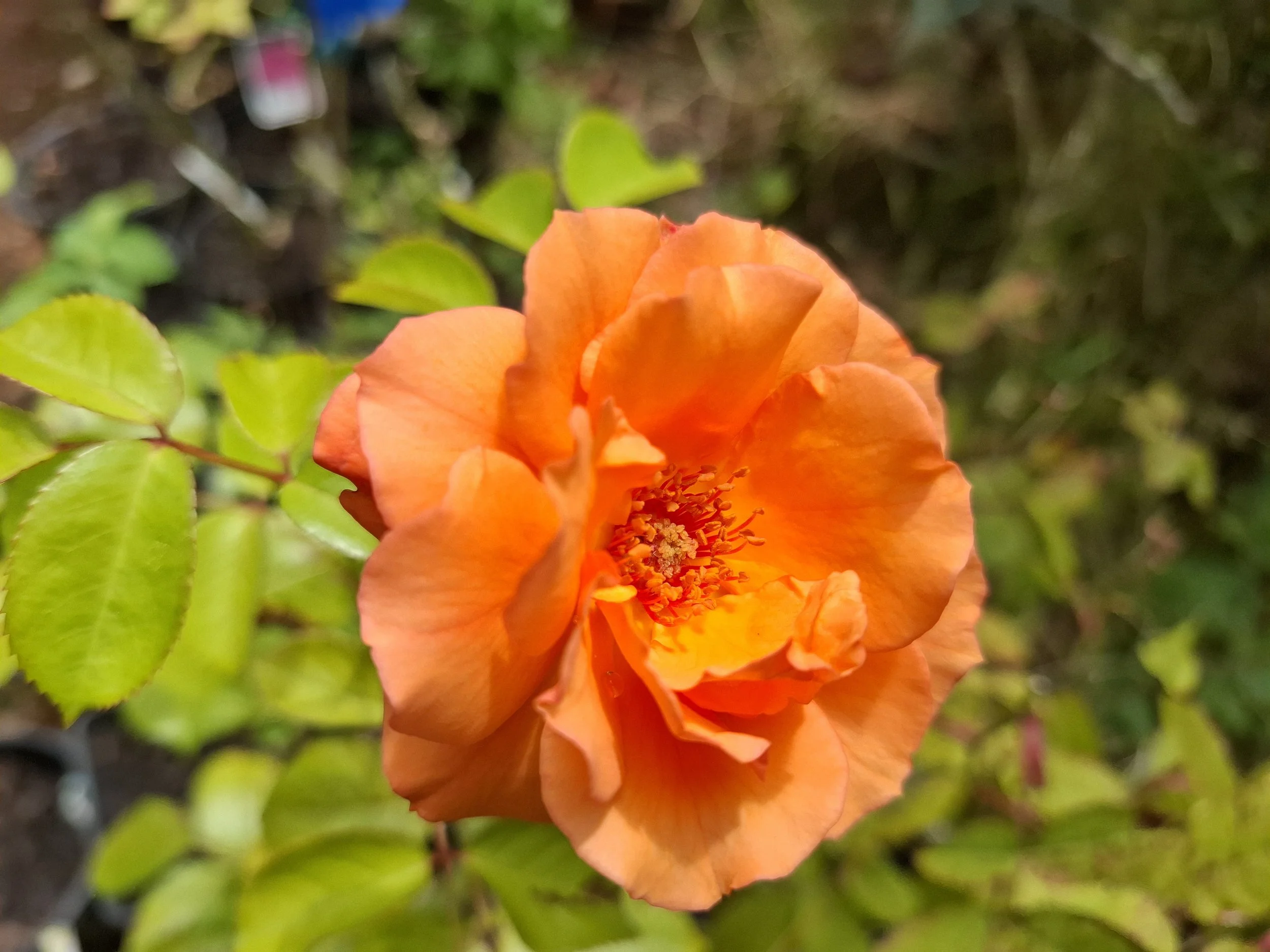
["China Sunrise" named for Mr. Zhang Zuoshuang]
On this occasion, on arrival at Beijing on Saturday, 21 May 2005, we were met at the airport by Xu Guihua (the curator of the rose garden at the Beijing Botanical Garden) and taken to our hotel within the grounds. Later that night we had a lovely dinner with all our old friends from the Gardens including some new guests; Miss Li, a very nice lady who told us she was a “heart doctor” and often brought her colleagues to look at our roses growing in the Gardens, Mr Zhang a scientist working with satellite dishes, and Mr Qichao Zhang an expert on lotus growing. It was a most enjoyable evening but we had to apologise that we only knew about roses and nothing whatsoever about lotus growing!
Early next morning Sunday, 22 May, we were taken to our Old Rose Garden where Laurie commenced to record and catalogue the condition of each rose while I was taken to the Conservatory where a floral art demonstration was about to commence. Immediately, however, I bumped into an old friend, the Deputy Director of the Gardens, Dr Zhao Shiwei, who is in charge of that magnificent complex. Although very young he had just recovered from a heart scare, so it was nice to meet up with him personally and wish him well in his recovery. He and the Director and other dignitaries were participating in a prize-giving ceremony for about 20 students who had competed in a writing contest run by the Gardens. Speeches were made telling the students about the importance of the care of the environment etc. and each was given a red bound certificate, and photographed on stage. Afterwards students from a Floral Art School completed various arrangements on stage which were to a very high standard and having made friends with their teacher, I was able to discuss how their work would have been judged in Australia and how well her students would have performed in any competitive work (I am a member and judge of the Victorian Floral Art Judges Association). The works were very advanced for the students’ ages – boys as well as girls, aged between 18 – 24 years I would guess, and with the assistance of a microphone and a presenter, they told the audience about their arrangements. Various types of “structures” and roses were used in many of the arrangements and I took numerous photographs. Following this demonstration I was taken to another part of the Gardens to a large building normally housing Bonsai, but during this floral art event, used to display numerous floral art arrangements in various rooms. Many arrangements were creative and modern and I spent some time photographing nearly every one of them as the standard of the work was so impressive.
Early next morning, Monday, 23 May, Laurie and I went for a walk down to the Old Rose Garden – it was a clear and sunny day and as usual large numbers of visitors had already streamed through the gates despite the early hour. On all our trips to the Gardens we are amazed at the interest shown in our roses by local visitors to the Gardens – bus loads of school children and university students stop to admire and photograph and discuss the roses before wandering away to enjoy other areas of interest and study available to them within the Gardens. We also took lots of photographs of our roses from Silvan which were in various stages of bloom and the Old Rose Garden was looking particularly beautiful. Following lunch we were driven to the airport to catch our flight to Urumqi in Xinjiang Province, Western China, along with our companion and interpreter on the trip, Wang Kang (a computer expert at the Gardens). Four hours later after flying across vast deserts followed by magnificent snow-capped mountains which were absolutely breathtaking, we landed at Urumqi Airport where we were met by members of the Urumqi Botanical Gardens who drove us to our very impressive five star hotel. Within a short time we were met by other members of staff, the Director, Vice Director, Chief Horticulturalist and their friendly driver and together with Wang Kang, had a very enjoyable dinner in the hotel restaurant (serenaded in the background by an accomplished young pianist and a violinist). Our conversation that night centred around a very significant plant in the rose world which we were hoping to see growing in Urumqi which was the reason for our trip to Western China. None of our hosts spoke English so we were particularly pleased that we had arranged for Wang Kang to accompany us, as we could never have managed without him. We discussed Hulthemia persica and/or H. berberifolia – which we understood, was now apparently only found in parts of Russia, Iran and Western China and which we were eager to see for ourselves. Presently there is uncertainty about whether the plant is actually Hulthemia persica or H. berberifolia, and Laurie was interested in trying to identify it to establish whether it was one and the same for a paper he proposed writing.
The city of Urumqi turned out to be like any other large modern city. The Director of the Urumqi Botanical Garden (a close friend of the Director of the Beijing Botanical Garden) and members of his Staff were our hosts for the four days of our visit and looked after us superbly and we are indebted to them for their hospitality, generosity and kindness.
On Tuesday, 24 May, we were collected early in the morning on what turned out to be a bright sunny day and driven immediately to an area where Hulthemia was located – only about 10 kms from the City and naturalized along the motorway! We were absolutely thrilled as only rose people can be – here we were seeing a species rose that was so rare it was almost extinct in the rest of the world and we spent the morning photographing it every which way with still cameras, digital cameras and video cameras! The plants were naturalized in patches along the motorway and growing in very dry, barren soil, amongst loose stones and rocks. Laurie used the back of the utility truck to set up his tripod to photograph various parts of the plant and I took photographs of him doing so, for posterity – all this while traffic was flying along the motorway within a few feet of us (we would have died happy anyway!). I don’t know about Laurie, but I was in my element photographing the plant from every angle imaginable and took some specimens for later study.
After we had had our fill of that particular area (and we were reluctant to leave it!) we were driven a further kilometre or so up the highway to another clump of these plants, which we again photographed. We were then driven to a vineyard which was also a recreational area with restaurant facilities etc. and walked the full length of it to a deserted area at the very far end which was cordoned off, where we found that the plants here were being hybridized by “other people” we were told and not by staff from the Gardens. Again we gingerly stepped very carefully amongst the plants taking photographs – I understand that in the UK it had taken about 20 years or more to gain a little success with hybridising after seeds from Iran were sent to the nurseryman Cocker in Scotland, who in turn shared them with his nurseryman friend in London, Jack Harkness. It was really interesting to learn that Chinese nurserymen/students in 2005 were also trying their hand at breeding from these rare plants. What pollen from what rose was used in the pollination process was impossible for us to know as the labels were all in code, and Chinese code at that.
Following a most enjoyable lunch within the Urumqi Botanical Garden’s restaurant area, we were driven to the city’s Herbarium where we were able to study specimens of Hulthemia found by a couple of botanists in years past and it was extremely interesting looking through a microscope at the minute details of our specimens in comparison to theirs. As before, we took lots of photographs and had the whole facility to ourselves, once again thanks to arrangements previously made on our behalf by our hosts. Those Staff were also immediately able to access a bookshop and purchase an encyclopedic work on roses, which although in Chinese had some very detailed drawings of various species roses found in China, which I felt would be useful to bring back to Australia for future study. Laurie made some notes (and sketches) of the characteristics of Hulthemia persica and H. berberifolia and came to the conclusion that they were one and the same (as was my humble opinion). If you are interested in Laurie’s findings, you may like to access our website www.reliableroses.com.au and follow the prompts to “Xinjiang”.
All in all, it was one of the most memorable and enjoyable days of my life. Here we were seeing a plant that we had only previously read about in rose literature and which is apparently quite rare in the rest of the world so it was a unique and wonderful opportunity to photograph and study it for ourselves.
On Wednesday, 25 May, we were taken to Tian Chi, the Heavenly Lake, about 125 kms east of Urumqi. On the way we noticed what appeared to be some yellow roses naturalised along the roadside which we were told we could photograph on the way back. We arrived at our destination and after boarding a small tourist bus and ascending approximately 20 hairpin bends to the top, finally reached the magnificent lake which was located within the “bowl” of an enormous mountain range. The view was spectacular and we were told the area is a very popular tourist attraction. We walked about a kilometre spotting clumps of wild flowers and species roses - R. xanthina spontanea (?) - naturalized along the mountainsides which we stopped and photographed. We also took photos of the huge lake which, as the weather closed in and grew wetter and colder, gradually became covered in mist. On our return trip we suddenly noticed that bush of yellow roses we had passed by earlier in the day and stopped the car and photographed it - a bit of a precarious position growing along a fairly steep, wet and slippery embankment parallel to a concrete channel of fast flowing water – Laurie was horrified when he saw the narrow and dangerous track I had crossed to get a closer look at the simple five-petalled and delicate lemon coloured blooms – which were quite breathtaking in the wet and misty cold mountain air – but again I would have died happy with camera in hand!! We spent some time photographing and taking small specimens of the plant for later study and then headed back along the road again to the main highway leading back to Urumqi. All of a sudden Laurie noticed a large shrub with white blooms which he thought might be a rose bush, growing along the roadside so we stopped the car and walked back and found that it was indeed a rose, another species rose, which he has subsequently identified and believes to be R. tibetica (?). Again we admired and photographed this delicate beauty, studied its various characteristics and then continued on our way. About 10 kms from the main highway I suddenly saw what appeared to be a large rose bush so I called out to the driver to stop the car again (just as Roger Phillips and Martyn Rix had done in their TV series on plant hunting in China a few years ago!) and went running back to discover that it was indeed a lovely pink rugosa rose growing in the corner of a small house yard where garbage was thrown. Not deterred, we gingerly stepped around the rubble taking photographs of yet another unknown beauty. By this time it was late afternoon and being famished headed for the nearest town where we stopped for lunch en route to our hotel. Back in our room, we reflected on what had turned out to be a most enjoyable, eventful and satisfying day. Here we were in a remote area of the world, seeing wild roses growing naturally along the highways and byways of China – a rare opportunity for us indeed, and we loved every minute of it! That night a banquet was held in our honour and we were wined and dined by the Director and Deputy Director of the Gardens and about 15 members of his friendly and charming staff. Considering only about four of us spoke English, it was a wonderfully enjoyable evening full of good humour and frivolity, excellent food (about 30 dishes!), conversation recalling our friends in Beijing, and anecdotes about our respective countries and the rose.
The next day Thursday, 26 May, we were collected in the morning by two members of staff from the Urumqi Botanical Garden and driven to a Muslim area of the City – a famous tourist area – to buy souvenirs from their “bazaar”. Although the craftsmanship was very good, it turned out that almost every shop had the same goods: musical instruments, binoculars, leather goods, metal goods and jewellery. After wandering around in very hot conditions buying numerous souvenirs, I started to find the place a bit claustrophobic as many of the stalls were in an enclosed building. We headed for lunch which was on the fourth floor of a restaurant, which unfortunately had no air-conditioning, so we were glad when it came time to leave. We headed back to our hotel room (Laurie went with our interpreter in search of some Chinese language books as he has been studying Mandarin for many years) and I turned on the TV to find that Liverpool was playing AC Milan in the UEFA Cup. Being a soccer (and cricket) enthusiast, it was a lovely surprise as the match had been advertised in Australia long before our trip and we thought we would miss it. Of course the commentary was in Chinese, but it was great just being able to see the match in this far flung corner of the world and see Liverpool win the Cup.
Later in the early evening we were picked up and taken to the same Muslim market area we had been shopping in earlier in the day, but this time we went into an upper storey of the building and entered a huge hall crowded with people all watching a magnificent dance extravaganza. The enormous stage was full of dancers in glorious lime green, shimmering costumes which Laurie and I (being the typical tourists) immediately started videoing as we walked from the doorway of the hall to our places at a long trestle table – it was such an amazing sight. When we finally dragged our eyes away from the dancers in their colourful native costumes we saw that the other members at our table were the Director and Deputy Director and other members of staff from the Urumqi Botanical Garden who had arrived earlier. A wonderful buffet dinner followed as we watched numerous acts throughout the night including singers, dancers, and at one stage, an auction of paintings and other artifacts from this region. Unbeknown to me the Director successfully bid for a small musical string instrument (like a banjo) and presented it to me as a gift (much to my embarrassment as I dreaded to think what he had bid). It was such an extremely spontaneous thing to do and so sweet of him that I thanked him profusely for his kindness. The dancing, with numerous costume changes each one better than the last, continued throughout the night and was truly amazing – a magnificent and outstanding example of native dance. Laurie and I had an absolute ball, but it didn’t end there, because as the night drew to a close, there was a Grand Finale where all the entertainers came down from the stage and joined the audience encouraging each and all to dance with them around the huge hall. Laurie had a great time joining a “conga line” and then he and one of the lead male dancers stood on an “island” stage in the middle of the dining hall and Laurie had to copy every move the dancer made, an amusing and hilarious sight for hundreds of onlookers!
Early Friday, 27 May, we were collected and taken to the airport where we met up with the Director (who had arrived ahead of us) and we thanked him sincerely and wholeheartedly for looking after us so well and giving us such a good time in his city. Sadly, we said our goodbyes just before we boarded our Southern China flight back to Beijing. Four hours later across those snow-covered mountains and vast deserts, we were back in Beijing and met by one of the drivers from the Beijing Botanical Garden and taken back to our hotel. Laurie was unfortunately unwell after eating something which didn’t agree with him and had to retire to his room. I decided to go for a long walk to our Old Rose Garden to take some photos as we were leaving Beijing at 1.00 p.m. the next day to return to Australia – only four days had passed, but the roses were out in full bloom now and looking magnificent.
Saturday morning after breakfast on 28 May, feeling rather sad at having to leave Beijing, I went for one last look at our lovely Old Rose Garden. It was a glorious morning and the roses had been looking particularly beautiful the day before so I wanted to take photographs and video them to show Laurie later, as he was still in bed sick and wouldn’t get to see them before we flew home. Later we had a farewell lunch with the Director who introduced us to his Chinese friend, Dr Zhu Guanghua*, who also joined us, a botanist from Missouri, USA, and we were able to talk to that very knowledgeable and friendly gentleman about our findings in Urumqi as he spoke perfect English. It was a wonderful opportunity to discuss all the species roses we had seen on our trip to the west with someone who had a similar interest, and a very animated conversation ensued around the table. Following lunch the Director presented Laurie and I with a beautiful crystal trophy to thank us for our assistance at their First National Rose Show in Zhengzhou which we had attended the previous month (April 2005), together with some fine words inscribed in a red leather bound certificate. It was a really lovely surprise and absolutely and totally unexpected. We were also given an intricately designed gold decorated tea caddy – a very fine example of Chinese craftsmanship. Sadly, once again, we said our goodbyes to the Director and to our other friends at the Beijing Botanical Garden and were then driven to the Airport to catch our flight back to Australia.
It had been an extremely enjoyable trip made all the more enjoyable because we actually found the rare Hulthemia we had been hoping to locate. We found out later that when the Director of the Urumqi Botanical Garden was told of our impending visit to try and locate this plant (by his Director friend in Beijing), his staff had books which told them in which part of their region the plant could be found, so drivers were sent out into the countryside to locate them. That is why, when we arrived, they were able to take us straight to the area where the plants were located, and we did not have to go traipsing around the countryside andentering unknown territory because staff members had already prepared the groundwork.
During our trip we made many friends in Urumqi and as their Botanical Garden does not presently have a rose garden we have offered to donate rose plants to assist them in establishing one in the not too distant future – a small gift for the genuine friendship and tremendous assistance we had received in locating our rare plant.
Jean Newman
Reliable Roses
* We were shocked and terribly saddened to learn that our botanist friend, Dr Zhu Guanghua (aged 41) from St. Louis, Missouri, USA, passed away on 2 November 2005 following an illness with cancer, leaving a wife and 5 year old son.